Series Navigation: Part 1: Foundation & Execution • Part 2 (You are here) • Part 3: Advanced Patterns
“The art of concurrent programming lies not in making things parallel, but in coordinating parallel things gracefully."
In Part 1 (Day 95), we covered foundation and execution patterns: Executor, ExecutorService, ScheduledExecutorService, Future, CompletableFuture, and CountDownLatch. These tools execute tasks concurrently.
Part 2 covers core synchronization patterns—the tools that coordinate threads and protect shared resources.
Series Overview#
This is a 3-part series on Java Concurrency:
Part 1 (Day 95): Foundation & Execution
- Executor, ExecutorService, ScheduledExecutorService
- Future, CompletableFuture, CountDownLatch
Part 2 (Today - Day 96): Core Synchronization Patterns
- CyclicBarrier, Semaphore, ThreadFactory, BlockingQueue
Part 3 (Day 97): Advanced Patterns & Production Readiness
- DelayQueue, ReentrantLock, Phaser
- Debugging, Monitoring, Production Patterns
What We’re Covering Today#
Part 2 (Today): Core Synchronization Patterns
- CyclicBarrier - Reusable multi-phase synchronization
- Semaphore - Resource pool management
- ThreadFactory - Production-ready thread management
- BlockingQueue - Producer-consumer patterns
| Tool | TL;DR | Caveat |
|---|
| CyclicBarrier | Reusable synchronization checkpoint for fixed threads. All must arrive before any proceed. | Fixed party count. If one thread fails, all block forever |
| Semaphore | Controls concurrent access to limited resources. Think “permission slips” (N max). | Must release in finally - easy to leak permits |
| ThreadFactory | Customizes thread creation. Name your threads for debugging! | Daemon threads die when JVM exits - bad for critical work |
| BlockingQueue | Decouples producers/consumers with thread-safe queue. Built-in backpressure. | Unbounded queues = OOM. Use bounded ArrayBlockingQueue |
The Coordination Challenge#
Part 1 showed how to execute work concurrently. But execution alone isn’t enough. Real systems need coordination:
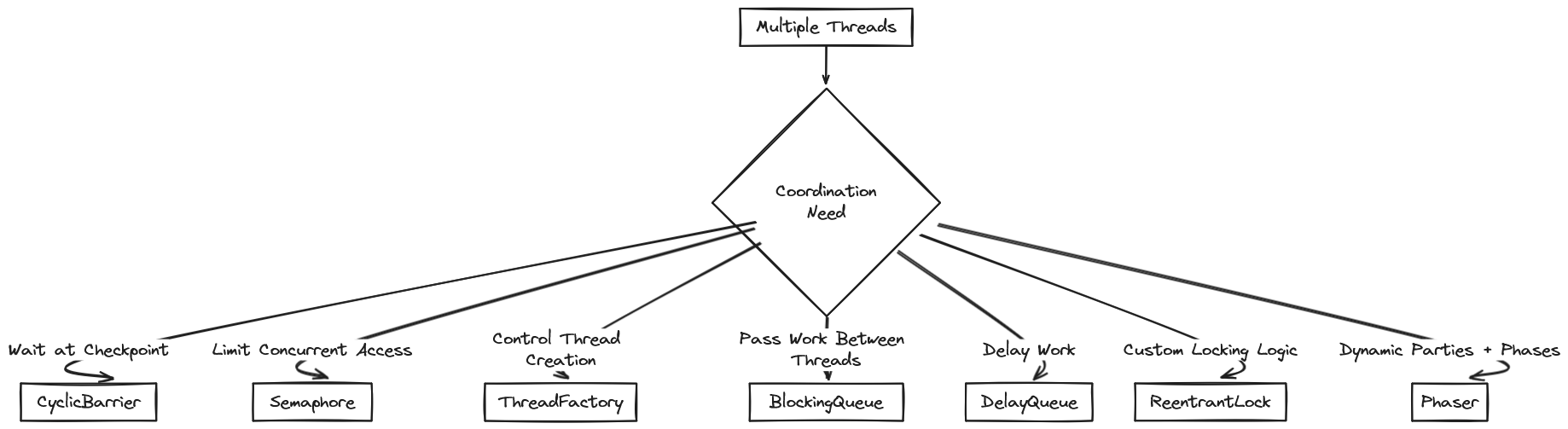
Think of it like a construction project:
- Workers need to sync at checkpoints (CyclicBarrier)
- Only X workers can use the crane at once (Semaphore)
- Workers need proper uniforms and tools (ThreadFactory)
- Materials move between stations (BlockingQueue)
1. CyclicBarrier: Multi-Phase Processing#
The Problem: You’re processing a large dataset in three phases: Extract → Transform → Load. Each phase must finish across all threads before the next begins.
Use CyclicBarrier for batch processing with distinct phases. Unlike CountDownLatch (one-shot), CyclicBarrier resets after each phase. This makes iterative processing simple.
The Solution: Synchronized phase transitions with CyclicBarrier.
 1
 2
 3
 4
 5
 6
 7
 8
 9
10
11
12
13
14
15
16
17
18
19
20
21
22
23
24
25
26
27
28
29
30
31
32
33
34
35
36
37
38
39
40
41
42
43
44
45
46
47
48
49
50
51
52
53
54
55
56
57
58
| import java.util.concurrent.*;
import java.util.stream.IntStream;
public class BatchProcessor {
private final int workerCount;
public BatchProcessor(int workerCount) {
this.workerCount = workerCount;
}
public void processBatch() throws InterruptedException {
CyclicBarrier barrier = new CyclicBarrier(
workerCount,
() -> System.out.println("--- Phase completed. All workers synchronized ---")
);
ExecutorService pool = Executors.newFixedThreadPool(workerCount);
Runnable worker = () -> {
try {
String threadName = Thread.currentThread().getName();
// Phase 1: Extract
System.out.println(threadName + " - Extracting data...");
Thread.sleep(ThreadLocalRandom.current().nextInt(500, 1500));
System.out.println(threadName + " - Extract complete");
barrier.await(); // Wait for all threads to finish Phase 1
// Phase 2: Transform
System.out.println(threadName + " - Transforming data...");
Thread.sleep(ThreadLocalRandom.current().nextInt(500, 1500));
System.out.println(threadName + " - Transform complete");
barrier.await(); // Wait for all threads to finish Phase 2
// Phase 3: Load
System.out.println(threadName + " - Loading data...");
Thread.sleep(ThreadLocalRandom.current().nextInt(500, 1500));
System.out.println(threadName + " - Load complete");
barrier.await(); // Wait for all threads to finish Phase 3
} catch (InterruptedException | BrokenBarrierException e) {
System.err.println("Worker interrupted: " + e.getMessage());
}
};
// Submit all workers
IntStream.range(0, workerCount)
.forEach(i -> pool.submit(worker));
pool.shutdown();
pool.awaitTermination(1, TimeUnit.MINUTES);
System.out.println("Batch processing complete!");
}
}
|
Key Difference from CountDownLatch: CyclicBarrier is reusable. After all threads reach the barrier, it resets automatically. Use it for iterative or phase-based processing.
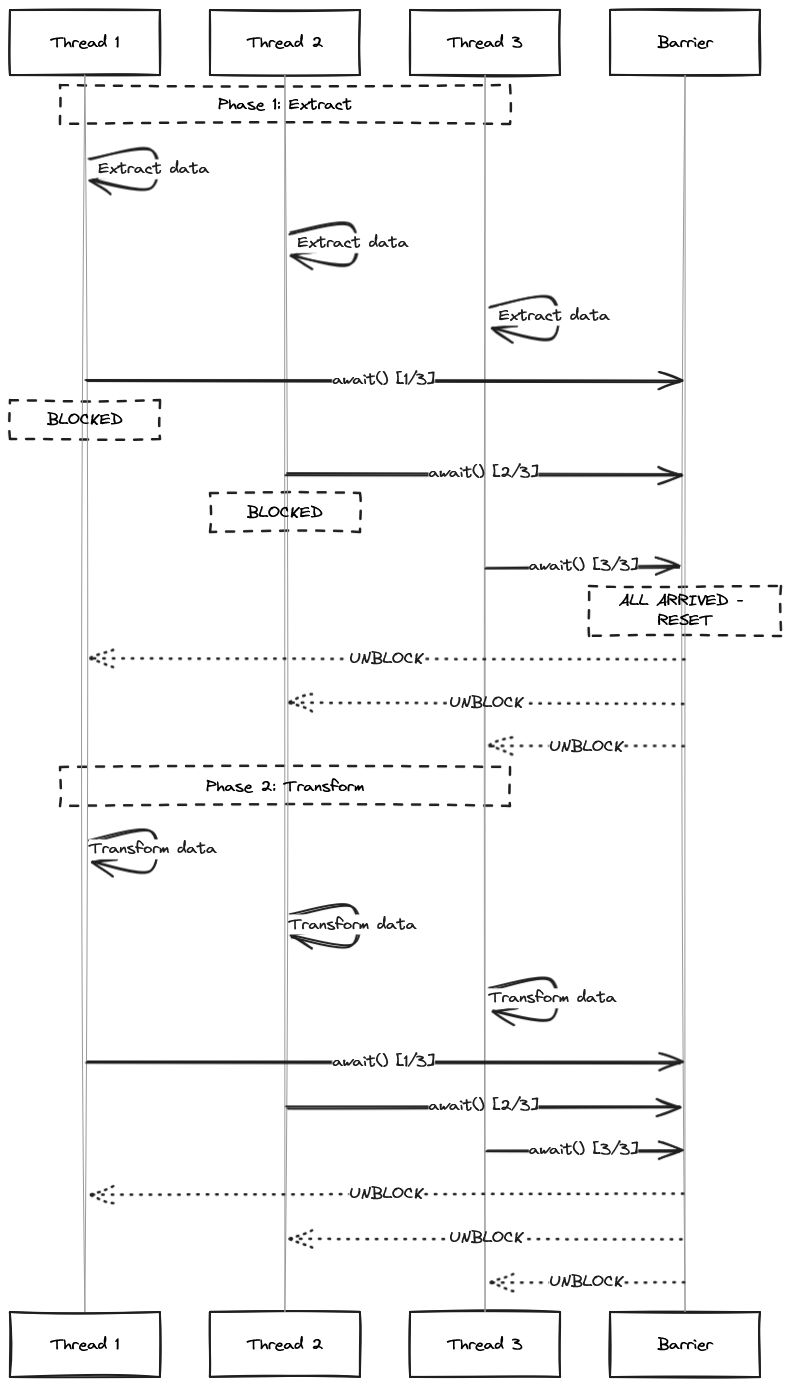
Visualizing CyclicBarrier#
Here’s a sequence diagram showing how CyclicBarrier works:
Trade-offs and Limitations#
Pros:
- Reusable (unlike CountDownLatch)
- Built-in barrier action (callback when all arrive)
- Low overhead
- Thread-safe reset
Cons:
- Fixed number of parties (must be known at creation)
- If one thread fails, others wait forever (unless you handle BrokenBarrierException)
- No dynamic party registration (use Phaser instead)
- All threads must reach barrier together (can’t have stragglers)
Common Mistakes:
 1
 2
 3
 4
 5
 6
 7
 8
 9
10
11
12
13
14
15
16
17
18
19
20
21
22
23
24
25
26
27
28
29
30
31
32
33
34
35
36
37
38
39
40
41
42
43
44
45
46
47
48
| // MISTAKE 1: Wrong party count
CyclicBarrier barrier = new CyclicBarrier(5);
for (int i = 0; i < 3; i++) { // Only 3 threads!
pool.submit(() -> {
doWork();
barrier.await(); // Blocks forever! Only 3/5 arrived
});
}
// CORRECT: Match party count
int parties = 3;
CyclicBarrier barrier = new CyclicBarrier(parties);
for (int i = 0; i < parties; i++) {
pool.submit(() -> {
doWork();
barrier.await();
});
}
// MISTAKE 2: Not handling BrokenBarrierException
pool.submit(() -> {
doWork();
barrier.await(); // What if another thread throws exception?
});
// CORRECT: Handle broken barrier
pool.submit(() -> {
try {
doWork();
barrier.await();
} catch (BrokenBarrierException e) {
System.err.println("Barrier broken! Aborting.");
// Cleanup and exit
} catch (InterruptedException e) {
Thread.currentThread().interrupt();
}
});
// MISTAKE 3: Reusing after reset without checking
if (barrier.isBroken()) {
barrier.reset(); // Must reset explicitly if broken
}
// CORRECT: Check state before reuse
if (barrier.isBroken()) {
barrier.reset();
}
barrier.await();
|
When to Use:
- Fixed number of worker threads
- Multi-phase processing where all must complete each phase
- Iterative algorithms (simulations, game loops)
Don’t use when:
- You need dynamic party count (use Phaser)
- You need one-shot synchronization (use CountDownLatch)
2. Semaphore: Resource Pool Management#
The Problem: Your database connection pool has 10 connections. If 50 threads query simultaneously, you overwhelm the pool and get timeouts.
Semaphore limits concurrent access to finite resources. Acquire a permit before using the resource, release it when done.
The Solution: Limit concurrent access with Semaphore.
 1
 2
 3
 4
 5
 6
 7
 8
 9
10
11
12
13
14
15
16
17
18
19
20
21
22
23
24
25
26
27
28
29
30
31
32
33
34
35
36
37
38
39
40
41
42
43
44
45
46
47
48
49
50
51
52
53
54
55
56
57
58
59
60
61
62
63
64
65
66
| import java.util.concurrent.*;
public class DatabaseService {
private final Semaphore connectionPermits;
private final int maxConnections;
public DatabaseService(int maxConnections) {
this.maxConnections = maxConnections;
this.connectionPermits = new Semaphore(maxConnections, true); // fair=true for FIFO
}
public String executeQuery(String sql) {
System.out.println(Thread.currentThread().getName() + " - Requesting DB connection...");
try {
// Try to acquire permit (blocks if none available)
connectionPermits.acquire();
System.out.println(Thread.currentThread().getName() + " - Got connection! " +
"Available: " + connectionPermits.availablePermits() + "/" + maxConnections);
// Execute query
String result = runActualQuery(sql);
return result;
} catch (InterruptedException e) {
Thread.currentThread().interrupt();
return "Query interrupted";
} finally {
// Always release permit
connectionPermits.release();
System.out.println(Thread.currentThread().getName() + " - Released connection");
}
}
public boolean tryExecuteQueryWithTimeout(String sql, long timeoutMs) {
try {
// Try to acquire with timeout
if (connectionPermits.tryAcquire(timeoutMs, TimeUnit.MILLISECONDS)) {
try {
runActualQuery(sql);
return true;
} finally {
connectionPermits.release();
}
} else {
System.err.println("Could not acquire connection within " + timeoutMs + "ms");
return false;
}
} catch (InterruptedException e) {
Thread.currentThread().interrupt();
return false;
}
}
private String runActualQuery(String sql) {
// Simulate DB query
try {
Thread.sleep(1000);
} catch (InterruptedException e) {
Thread.currentThread().interrupt();
}
return "Result for: " + sql;
}
}
|
Pro Tip: Use tryAcquire() with timeout in request handlers to fail fast instead of blocking indefinitely. Your users will thank you.
Trade-offs and Limitations#
Pros:
- Simple API (acquire/release)
- Supports fair vs non-fair modes
- Can try with timeout
- Can query available permits
- Very low overhead
Cons:
- No automatic resource management (must call release in finally)
- Permits can be released by any thread (not tied to acquirer)
- No built-in timeout enforcement on resource usage
- Can accidentally create permit leaks
Common Mistakes:
 1
 2
 3
 4
 5
 6
 7
 8
 9
10
11
12
13
14
15
16
17
18
19
20
21
22
23
24
25
26
27
28
29
30
31
32
33
| // MISTAKE 1: Forgetting to release
semaphore.acquire();
doWork(); // What if this throws?
semaphore.release(); // Never called!
// CORRECT: Always use try-finally
semaphore.acquire();
try {
doWork();
} finally {
semaphore.release(); // Always happens
}
// MISTAKE 2: Releasing without acquiring
semaphore.release(); // Increases permit count above initial!
// This creates "phantom permits" that break your resource limit
// CORRECT: Only release what you acquired
boolean acquired = semaphore.tryAcquire();
if (acquired) {
try {
doWork();
} finally {
semaphore.release();
}
}
// MISTAKE 3: Using unfair mode for critical resources
Semaphore semaphore = new Semaphore(1, false); // unfair
// Threads can "cut in line" causing starvation
// CORRECT: Use fair mode for critical resources
Semaphore semaphore = new Semaphore(1, true); // fair = FIFO
|
What is Fair/Unfair in a Semaphore#
I’ve mentioned fair/unfair mode in the code above. Here’s what they mean:
Semaphore operates in either fair or unfair mode. This determines the order waiting threads acquire permits. You trade guaranteed access for throughput.
Fair Mode:
- Threads acquire permits in request order (FIFO queue)
- The longest-waiting thread gets the next available permit
- Prevents starvation—no thread waits forever while new threads keep acquiring permits
- Use for critical resources like database connection pools
Unfair Mode:
- Better performance—no FIFO queue overhead means fewer context switches
- Higher throughput but some threads might starve
To create a fair semaphore, you use the constructor new Semaphore(int permits, true).
Real-World Use Cases:
- Database connection pools
- API rate limiting (X requests per second)
- Limited worker threads for CPU-intensive tasks
- Bounded parallelism in file I/O
Integration Example: Rate Limiting#
 1
 2
 3
 4
 5
 6
 7
 8
 9
10
11
12
13
14
15
16
17
18
19
20
21
22
| public class RateLimiter {
private final Semaphore permits;
private final ScheduledExecutorService refiller;
public RateLimiter(int permitsPerSecond) {
this.permits = new Semaphore(permitsPerSecond, true);
this.refiller = Executors.newScheduledThreadPool(1);
// Refill permits every second
refiller.scheduleAtFixedRate(() -> {
int available = permits.availablePermits();
int toAdd = permitsPerSecond - available;
if (toAdd > 0) {
permits.release(toAdd);
}
}, 1, 1, TimeUnit.SECONDS);
}
public boolean tryAcquire() {
return permits.tryAcquire();
}
}
|
3. ThreadFactory: Production-Ready Thread Management#
The Problem: Your thread dump shows dozens of threads named pool-1-thread-X. You can’t debug which pool causes the issue.
Custom ThreadFactory gives you control over thread creation. Name threads for easier debugging and monitoring.
The Solution: Custom ThreadFactory with meaningful names and proper configuration.
 1
 2
 3
 4
 5
 6
 7
 8
 9
10
11
12
13
14
15
16
17
18
19
20
21
22
23
24
25
26
27
28
29
30
31
32
33
34
35
36
37
38
39
40
41
42
43
44
45
46
47
48
49
50
51
52
53
54
55
56
| import java.util.concurrent.*;
import java.util.concurrent.atomic.AtomicInteger;
public class NamedThreadFactory implements ThreadFactory {
private final String namePrefix;
private final AtomicInteger threadNumber;
private final boolean daemon;
private final int priority;
public NamedThreadFactory(String namePrefix, boolean daemon, int priority) {
this.namePrefix = namePrefix;
this.daemon = daemon;
this.priority = priority;
this.threadNumber = new AtomicInteger(1);
}
@Override
public Thread newThread(Runnable r) {
Thread t = new Thread(r);
t.setName(namePrefix + "-" + threadNumber.getAndIncrement());
t.setDaemon(daemon);
t.setPriority(priority);
// Add uncaught exception handler
t.setUncaughtExceptionHandler((thread, throwable) -> {
System.err.println("Uncaught exception in " + thread.getName() + ": " +
throwable.getMessage());
// In production: send to error tracking service like sentry, rollbar etc
});
return t;
}
public static ExecutorService createNamedPool(String name, int size) {
return Executors.newFixedThreadPool(
size,
new NamedThreadFactory(name, false, Thread.NORM_PRIORITY)
);
}
}
// Usage example
class ServiceOrchestrator {
private final ExecutorService paymentPool;
private final ExecutorService notificationPool;
private final ExecutorService analyticsPool;
public ServiceOrchestrator() {
this.paymentPool = NamedThreadFactory.createNamedPool("payment-worker", 8);
this.notificationPool = NamedThreadFactory.createNamedPool("notification-worker", 4);
this.analyticsPool = NamedThreadFactory.createNamedPool("analytics-worker", 2);
}
// Now thread dumps show: payment-worker-1, notification-worker-1, analytics-worker-1
// Instead of: pool-1-thread-1, pool-2-thread-1, pool-3-thread-1
}
|
Production Checklist:
- Meaningful thread names
- Daemon status set correctly
- Uncaught exception handlers
- Appropriate priority levels
Trade-offs and Limitations#
Pros:
- Full control over thread properties
- Consistent naming for debugging
- Centralized exception handling
- Can add custom initialization logic
Cons:
- More boilerplate than default factories
- Easy to forget to use it
- Doesn’t prevent thread leaks (just makes them easier to find)
Common Mistakes:
 1
 2
 3
 4
 5
 6
 7
 8
 9
10
11
12
13
14
15
16
17
18
19
20
21
22
23
24
25
26
27
28
29
30
31
32
33
34
35
36
37
38
39
40
41
42
43
44
45
46
47
48
49
50
| // MISTAKE 1: Using daemon threads for critical work
ThreadFactory factory = r -> {
Thread t = new Thread(r);
t.setDaemon(true); // JVM can exit while thread is running!
return t;
};
ExecutorService pool = Executors.newFixedThreadPool(10, factory);
pool.submit(() -> {
writeToDatabase(); // May not complete before JVM exits!
});
// CORRECT: Non-daemon for critical work
ThreadFactory factory = r -> {
Thread t = new Thread(r);
t.setDaemon(false); // JVM waits for completion
return t;
};
// MISTAKE 2: Not thread-safe counter
class BadFactory implements ThreadFactory {
private int counter = 0; // Not thread-safe!
public Thread newThread(Runnable r) {
return new Thread(r, "worker-" + counter++);
}
}
// CORRECT: Use AtomicInteger
class GoodFactory implements ThreadFactory {
private final AtomicInteger counter = new AtomicInteger(0);
public Thread newThread(Runnable r) {
return new Thread(r, "worker-" + counter.getAndIncrement());
}
}
// MISTAKE 3: Swallowing exceptions in handler
t.setUncaughtExceptionHandler((thread, throwable) -> {
// Just print? Exception is lost!
throwable.printStackTrace();
});
// CORRECT: Send to monitoring system
t.setUncaughtExceptionHandler((thread, throwable) -> {
logger.error("Uncaught exception in " + thread.getName(), throwable);
// Send to Sentry, Rollbar, etc.
errorTracker.captureException(throwable);
// Update metrics
exceptionCounter.increment();
});
|
Monitoring Integration#
 1
 2
 3
 4
 5
 6
 7
 8
 9
10
11
12
13
14
15
16
17
18
19
20
21
22
23
24
25
26
27
28
29
30
31
| public class MonitoredThreadFactory implements ThreadFactory {
private final String namePrefix;
private final AtomicInteger threadNumber = new AtomicInteger(1);
private final AtomicInteger createdThreads;
private final AtomicInteger activeThreads;
public MonitoredThreadFactory(String namePrefix, MeterRegistry registry) {
this.namePrefix = namePrefix;
this.createdThreads = registry.gauge("threads.created",
Tags.of("pool", namePrefix), new AtomicInteger(0));
this.activeThreads = registry.gauge("threads.active",
Tags.of("pool", namePrefix), new AtomicInteger(0));
}
@Override
public Thread newThread(Runnable r) {
createdThreads.incrementAndGet();
activeThreads.incrementAndGet();
Thread t = new Thread(() -> {
try {
r.run();
} finally {
activeThreads.decrementAndGet();
}
});
t.setName(namePrefix + "-" + threadNumber.getAndIncrement());
return t;
}
}
|
4. BlockingQueue: The Producer-Consumer Pattern#
The Problem: Your service receives 1000 requests/second but processes only 100/second. Without buffering, you drop requests or crash.
BlockingQueue decouples work submission from execution. It provides natural backpressure when consumers can’t keep up.
The Solution: Decouple producers from consumers with a bounded queue.
 1
 2
 3
 4
 5
 6
 7
 8
 9
10
11
12
13
14
15
16
17
18
19
20
21
22
23
24
25
26
27
28
29
30
31
32
33
34
35
36
37
38
39
40
41
42
43
44
45
46
47
48
49
50
51
52
53
54
55
56
57
58
59
60
61
62
63
64
65
66
67
68
69
70
71
72
73
74
75
76
77
78
79
80
81
82
83
84
85
86
87
88
| import java.util.concurrent.*;
import java.nio.file.*;
import java.util.stream.Stream;
public class ImageProcessingPipeline {
private final BlockingQueue<Path> imageQueue;
private final ExecutorService producers;
private final ExecutorService consumers;
private volatile boolean running;
public ImageProcessingPipeline(int queueSize, int consumerCount) {
this.imageQueue = new ArrayBlockingQueue<>(queueSize);
this.producers = Executors.newSingleThreadExecutor(
new NamedThreadFactory("image-producer", false, Thread.NORM_PRIORITY)
);
this.consumers = Executors.newFixedThreadPool(
consumerCount,
new NamedThreadFactory("image-consumer", false, Thread.NORM_PRIORITY)
);
this.running = true;
}
public void start(Path imageDirectory) {
System.out.println("Starting image processing pipeline...");
// Producer: Read image files and add to queue
producers.submit(() -> {
try (Stream<Path> paths = Files.list(imageDirectory)) {
paths.filter(p -> p.toString().endsWith(".jpg"))
.forEach(path -> {
try {
System.out.println("Producer: Queuing " + path.getFileName());
imageQueue.put(path); // Blocks if queue is full
} catch (InterruptedException e) {
Thread.currentThread().interrupt();
}
});
// Signal completion by adding poison pills
for (int i = 0; i < Runtime.getRuntime().availableProcessors(); i++) {
imageQueue.put(Paths.get("STOP")); // Sentinel value
}
} catch (Exception e) {
System.err.println("Producer error: " + e.getMessage());
}
});
// Consumers: Process images from queue
int consumerCount = Runtime.getRuntime().availableProcessors();
for (int i = 0; i < consumerCount; i++) {
consumers.submit(() -> {
while (running) {
try {
Path image = imageQueue.take(); // Blocks if queue is empty
if (image.toString().equals("STOP")) {
System.out.println("Consumer received stop signal");
break;
}
System.out.println("Consumer: Processing " + image.getFileName());
compressImage(image);
} catch (InterruptedException e) {
Thread.currentThread().interrupt();
break;
}
}
});
}
}
private void compressImage(Path image) {
// Simulate compression work
try {
Thread.sleep(500);
System.out.println("Compressed: " + image.getFileName());
} catch (InterruptedException e) {
Thread.currentThread().interrupt();
}
}
public void shutdown() {
running = false;
producers.shutdown();
consumers.shutdown();
}
}
|
Key Pattern: Use the “poison pill” technique—a sentinel value (STOP in this example) that signals consumers to stop gracefully.
Trade-offs and Limitations#
Pros:
- Built-in backpressure (blocks when full)
- Thread-safe operations
- Natural decoupling of producers/consumers
- Multiple queue implementations (Array, Linked, Priority, etc.)
Cons:
- Bounded queues block producers when full
- Unbounded queues cause OOM
- No built-in monitoring for queue depth
- Poison pill pattern needs careful coordination
Queue Implementation Trade-offs:
| Implementation | Ordering | Bounded | Throughput | Use Case |
|---|
| ArrayBlockingQueue | FIFO | ✅ | High | Fixed capacity, predictable memory |
| LinkedBlockingQueue | FIFO | Optional | Medium | Variable load, unbounded acceptable |
| PriorityBlockingQueue | Priority | ❌ | Lower | Task prioritization needed |
| SynchronousQueue | N/A | N/A | Highest | Direct handoff (zero capacity) |
| DelayQueue | Delay time | ❌ | Medium | Delayed execution |
Common Mistakes:
 1
 2
 3
 4
 5
 6
 7
 8
 9
10
11
12
13
14
15
16
17
18
19
20
21
22
23
24
25
26
27
28
29
30
31
32
33
34
35
36
37
38
| // MISTAKE 1: Unbounded queue with slow consumers
BlockingQueue<Task> queue = new LinkedBlockingQueue<>(); // Unbounded!
// Producer adds 1000 items/sec, consumer processes 10/sec
// Queue grows to millions = OOM!
// CORRECT: Bounded queue with backpressure
BlockingQueue<Task> queue = new ArrayBlockingQueue<>(1000);
// Producer blocks when queue is full = natural backpressure
// MISTAKE 2: Not handling interruption
queue.put(task); // Blocks if full, but what if interrupted?
// CORRECT: Handle interruption
try {
queue.put(task);
} catch (InterruptedException e) {
Thread.currentThread().interrupt();
// Cleanup and exit gracefully
}
// MISTAKE 3: Poison pill per producer instead of per consumer
// 2 producers, 3 consumers
queue.put(STOP); // Only 1 consumer stops!
// CORRECT: One poison pill per consumer
int consumerCount = 3;
for (int i = 0; i < consumerCount; i++) {
queue.put(STOP);
}
// MISTAKE 4: Losing tasks on shutdown
pool.shutdown(); // Queued tasks might not complete!
// CORRECT: Drain queue before shutdown
pool.shutdown();
List<Runnable> unfinished = new ArrayList<>();
queue.drainTo(unfinished);
// Persist unfinished tasks for retry
|
Monitoring Queue Health#
 1
 2
 3
 4
 5
 6
 7
 8
 9
10
11
12
13
14
15
16
17
18
19
20
21
22
23
24
25
26
27
28
29
30
| public class MonitoredQueue<T> {
private final BlockingQueue<T> queue;
private final int capacity;
private final MeterRegistry registry;
public MonitoredQueue(int capacity, MeterRegistry registry) {
this.queue = new ArrayBlockingQueue<>(capacity);
this.capacity = capacity;
this.registry = registry;
// Monitor queue depth
registry.gauge("queue.size", queue, BlockingQueue::size);
registry.gauge("queue.utilization", queue,
q -> (double) q.size() / capacity);
}
public void put(T item) throws InterruptedException {
long startTime = System.nanoTime();
queue.put(item);
long duration = System.nanoTime() - startTime;
registry.timer("queue.put.time").record(duration, TimeUnit.NANOSECONDS);
// Alert if blocking for too long
if (duration > TimeUnit.SECONDS.toNanos(1)) {
logger.warn("Producer blocked for {}ms",
TimeUnit.NANOSECONDS.toMillis(duration));
}
}
}
|
Part 2 Summary: Core Synchronization Patterns#
We’ve covered 4 fundamental synchronization tools:
| Tool | Best For | Key Limitation |
|---|
| CyclicBarrier | Fixed multi-phase work | Can’t change party count |
| Semaphore | Resource limiting | Must remember to release |
| ThreadFactory | Thread customization | Doesn’t prevent leaks |
| BlockingQueue | Producer-consumer | Queue can grow unbounded |
Key Takeaways:
- CyclicBarrier resets after each phase—use for iterative multi-phase work
- Semaphore limits resource access—always release in try-finally
- ThreadFactory names threads—makes debugging at 2 AM possible
- BlockingQueue separates producers from consumers—always use bounded queues
Coming in Part 3 (Day 97):
- DelayQueue - Time-delayed execution with exponential backoff
- ReentrantLock - Fine-grained locking with timeouts
- Phaser - Dynamic multi-phase coordination
- Plus: Debugging techniques, monitoring patterns, and production readiness checklist
Previous: Day 95 - Java Concurrency Toolkit Part 1: Foundation & Execution Patterns
Next: Day 97 - Java Concurrency Toolkit Part 3: Advanced Patterns & Production Readiness