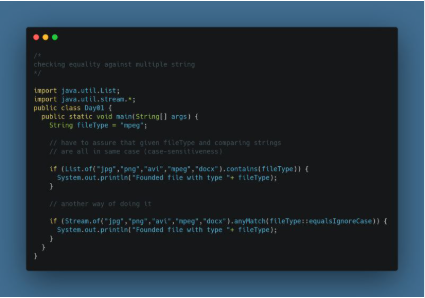
This example checks whether one string is equal to any value from a fixed set of allowed strings.
Transcribed from the original LinkedIn image post.
 1
 2
 3
 4
 5
 6
 7
 8
 9
10
11
12
13
14
15
16
17
18
19
20
21
22
23
| /*
Checking equality against multiple string
*/
import java.util.List;
import java.util.stream.*;
public class Day01 {
public static void main(String[] args) {
String fileType = "mpeg";
// have to assure that given fileType and comparing strings
// are all in same case (case-sensitiveness)
if (List.of("jpg", "png", "avi", "mpeg", "docx").contains(fileType)) {
System.out.println("Founded file with type " + fileType);
}
// another way of doing it
if (Stream.of("jpg", "png", "avi", "mpeg", "docx").anyMatch(fileType::equalsIgnoreCase)) {
System.out.println("Founded file with type " + fileType);
}
}
}
|
Which option should you use?#
For a small fixed list, List.of(...).contains(value) is simple and readable.
For repeated lookups or a larger set, keep the allowed values in a Set:
 1
 2
 3
 4
 5
 6
 7
 8
 9
10
11
12
13
14
| import java.util.Locale;
import java.util.Set;
public class Day01 {
private static final Set<String> ALLOWED_FILE_TYPES =
Set.of("jpg", "png", "avi", "mpeg", "docx");
public static void main(String[] args) {
String fileType = "mpeg";
if (ALLOWED_FILE_TYPES.contains(fileType.toLowerCase(Locale.ROOT))) {
System.out.println("Found file with type " + fileType);
}
}
}
|
If a project already uses Apache Commons Lang, Strings.CS.equalsAny(...) or the relevant case-insensitive variant can express this directly without creating a collection at the call site. Streams are better when this check is part of a longer pipeline, not just for a standalone membership test.
The original LinkedIn graphic is preserved below.